
As Energy Trading Week Europe kicks off in London this week, volatility and hedging are set to be dominant themes on the industry agenda.
While market participants debate strategies, technologies and regulations, we’re also hearing first-hand from our network that these trends are shaping the day-to-day realities of trading desks. This article explores how hedging strategies are evolving under volatility, and what that means for talent, recruitment and the future shape of energy trading teams.
Energy trading has always involved risk, but volatility isn’t just a background feature anymore, it’s now the defining pulse of the market. Between geopolitical uncertainty, renewable intermittency, and increasingly complex inter-commodity linkages, energy prices swing fast and unpredictably.
For Heads of Trading, these dynamics are not solely about P&L shocks; they’re also forcing a rethink of what makes a strong trading desk: not just models and systems, but skills, structure and talent.
Hedging in a New Era of Volatility
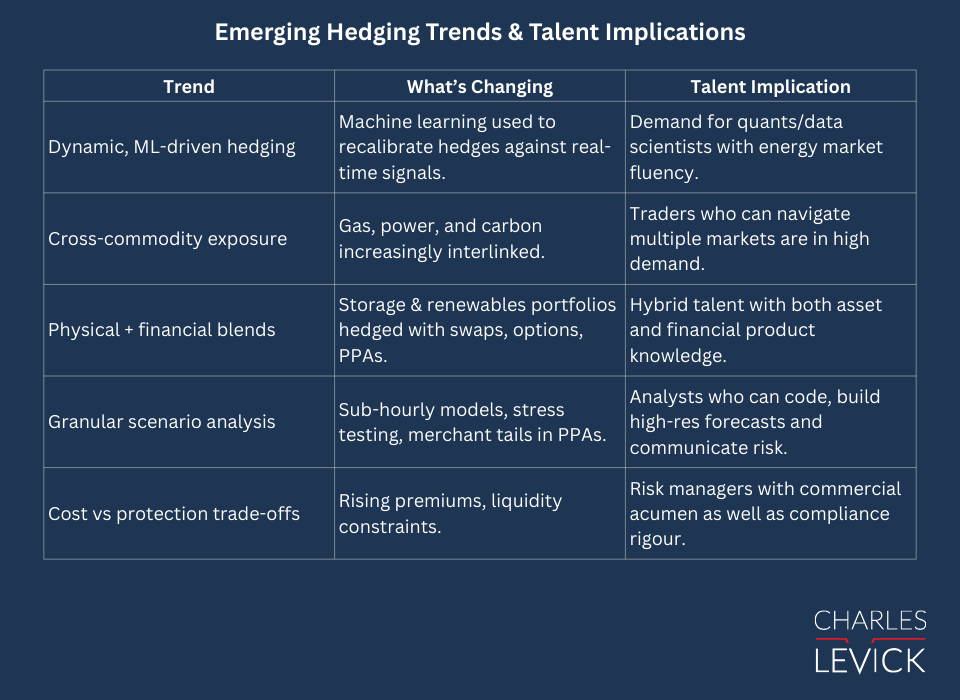
What we’re hearing from clients and candidates mirrors what industry leaders are writing. Montel has pointed out that firms are increasingly layering hedges across multiple time-frames to manage exposure, while Ascend Analyticshighlights how portfolios of renewables and storage are now blending physical and financial hedges to cope with weather-driven risks. Academic work on “deep hedging” of PPAs shows machine learning being applied to adjust strategies in real time.
Taken together, these insights reinforce the same point: hedging is becoming more complex, more dynamic, and more dependent on talent that can integrate data, models and market
What the energy trading talent market is telling us:
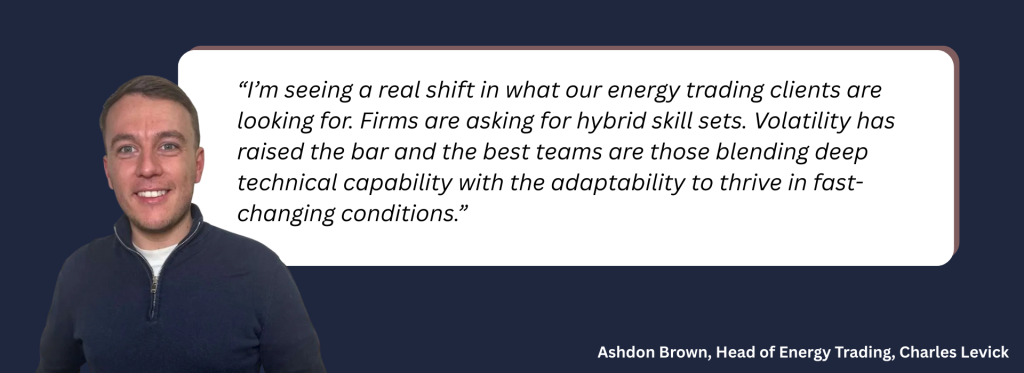
- Hybrid roles are on the rise. Quants asked to sit closer to the desk, traders asked to code, risk managers asked to stress-test complex scenarios.
- Cross-commodity experience is valued like never before. Desks want talent that can connect gas, power, and carbon positions.
- Physical and financial understanding are converging. Candidates are excited by roles that give them exposure to both sides.
- High performers in volatility are more mobile. Those with a strong track record in recent market swings know their skills command a premium.
Building the desk of the future
In short, talent strategy will directly impact trading strategy. Desks that can combine modelling sophistication with human adaptability will be best placed to navigate what comes next. For Heads of Trading, these trends translate into very practical recruitment questions:
- Do we have the right balance between traders, quants and risk professionals?
- Are we attracting candidates who can thrive in multi-commodity, data-rich environments?
- Are our compensation structures aligned with the new premium on volatility performance?
Volatility isn’t going away. If anything, it will intensify as renewables expand, weather patterns shift and policy uncertainty persists. Trading firms that succeed will be those who don’t just refine their hedging models, but also rethink how they build and retain teams.
At Charles Levick Limited , we’re working with clients worldwide to identify and attract the people who can perform in turbulent markets. If you’re scaling your desk or exploring your own career move, we’d love to connect. Get in touch with Ashdon Brown or Alicia Hutchinson.