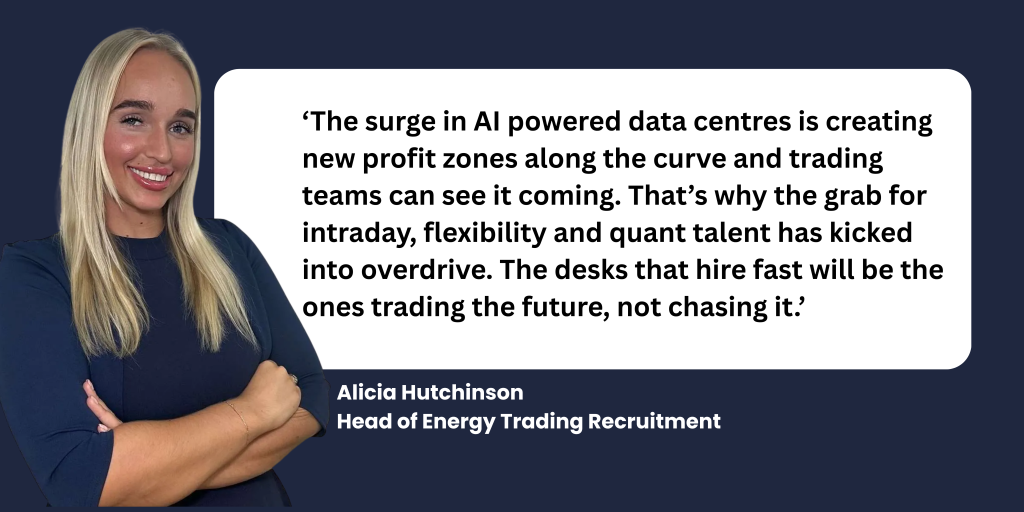
The acceleration of AI adoption isn’t just a technology story; it’s becoming a power-market story. With Private Equity (PE) investment in European energy infrastructure topping €38bn across 245 deals, much of it linked to data-centre growth, the question isn’t simply how the grid will cope, but how the landscape will shift.
AI power demand is rising exponentially. Accelerated servers are growing at ~30% per year, and according to IEA (International Energy Agency), the services supporting these centres are also expanding at roughly the same pace. At that rate, electricity use could nearly quadruple by 2029. Because this growth is clustered around data-centre hubs, the pressure on local grids will be uneven. Goldman Sachs estimates $720bn of grid investment is needed by 2030; if it lags, expect more congestion, tighter margins, and sharper intraday volatility.
Energy markets have always evolved in step with physical change. But the next wave, driven by hyperscale demand, constrained grids, and unprecedented capital inflows, could reshape the trading ecosystem more quickly than many expect.
Here are the key questions energy-trading organisations will need to answer in 2025–26.
1. Will intraday trading become the new strategic battleground?
AI data centres are constant, concentrated and sensitive to grid congestion. If their demand accelerates, we could see:
- More intraday volatility
- Tighter reserve margins
- A shift in profitability toward real-time optimisation
If so, firms may need a deeper bench of intraday specialists, grid analysts and optimisation quants. The question: will the market have enough of these people?
2. Are teams prepared for the surge in flexibility and optimisation talent?
Investment in batteries, VPPs and hybrid assets is accelerating. Future questions:
- Do trading houses need to double flexibility teams?
- Will asset-led trading become more quant-driven?
- Who manages the growing complexity between batteries, peakers and grid limits?
These roles are rare and competitive — likely among the hardest to hire in 2026.
3. How will AI/data-centre PPAs reshape the originator profile?
Hyperscalers now sign long-duration PPAs that must navigate congestion, carbon alignment and behind-the-meter options. This raises a key question:
Do current originator skillsets match the needs of AI/data-centre clients?
4. Is the sector ready for deeper quantification of power markets?
More congestion and complexity means heavier reliance on modelling and optimisation. Will trading teams need to hire quants at hedge‑fund scale?
5. How will Private Equity backed platforms build trading capability from scratch?
With billions flowing into assets, PE-backed IPPs must build trading teams earlier:
- Complete intraday, balancing, quant and analytics teams
- New risk and commercial leadership
- Compressed timelines and competitive hiring
6. Will new hybrid roles emerge at the intersection of energy and digital?
We expect new blended profiles:
- Grid Optimisation Quants: Build trading and dispatch models that factor in real grid constraints like congestion, curtailment and local balancing signals.
- Data-Centre PPA Structurers: Design long-term power agreements for hyperscalers, balancing price, location, carbon requirements and grid-capacity risk.
- Algorithmic Flexibility Traders: Use algorithms to optimise batteries, VPPs and flexible assets in real time, responding to imbalance prices and volatility spikes.
- AI-Augmented Risk Managers: Use AI-driven models to monitor, predict and manage market, operational and system risk with greater speed and granularity.
- Commercial Leads Fluent in Digital-Load Dynamics: Shape commercial strategy and partnerships by understanding how data-centre and AI-driven power demand affects pricing, grid constraints and long-term energy contracting.
These may become the defining hires of the decade.
What hiring leaders should do now:
- Scenario-plan your 2026 workforce
- Build relationships with specialist talent early
- Expect hybrid skillsets to command premiums
- Challenge whether current hiring plans are future-proof